
SEO and Organic Search
What Happens to AI-Generated Content in Google Rankings
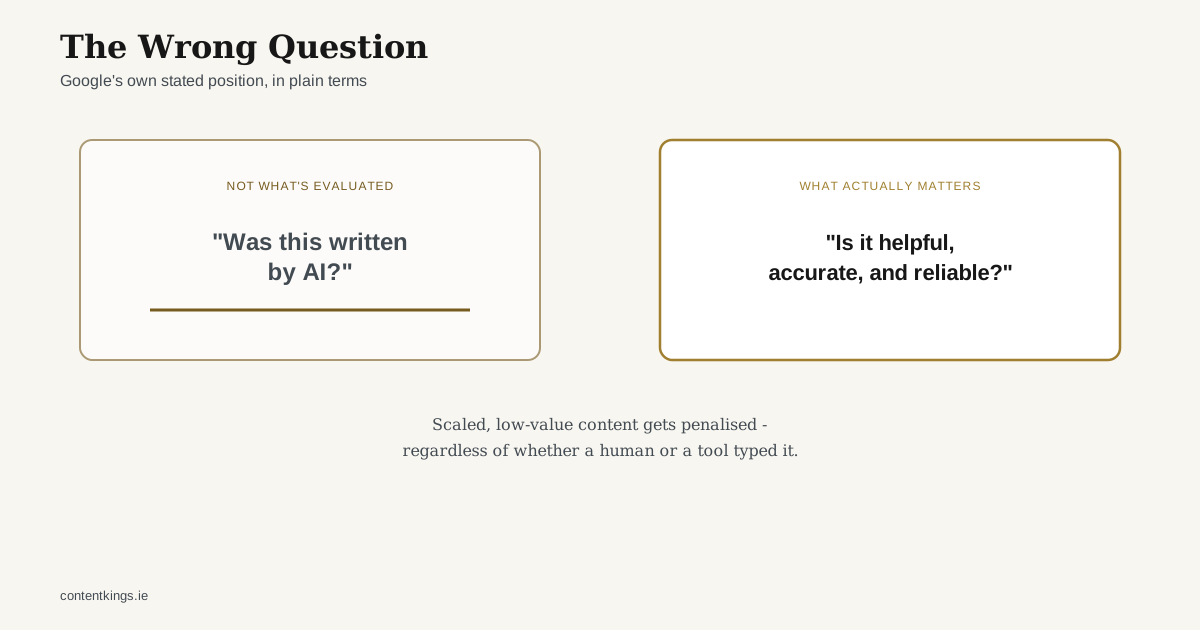
This is a question we get asked directly, usually by someone who’s either worried their AI-assisted content will be penalised, or hoping AI-generated content is a shortcut to ranking well without the work. Both assumptions are wrong, and Google has actually been fairly clear about why.
Google’s actual stated position
Google Search Central’s own guidance says, in substance, that how content is produced matters less than whether it’s helpful, reliable, and created for people rather than purely to manipulate rankings. That’s a deliberate shift away from an origin-based rule (“AI-written = bad”) toward a quality-based one (“unhelpful, unoriginal content = bad, regardless of how it was made”). This isn’t a loophole or a workaround we’re pointing to - it’s the actual, published position, and it’s consistent with how Google’s ranking systems have targeted low-quality content long before generative AI existed.
What this actually means in practice
Google doesn’t have a reliable “AI content detector” built into ranking, and isn’t claiming to. The quality signals it evaluates - does this page genuinely answer the query, is it accurate, does it add something beyond what’s already out there, does it come from a source with real expertise on the topic - are the same signals it’s always evaluated. AI-generated content can score well or badly on all of those, exactly like human-written content can.
What actually gets penalised is scaled, low-value content production - mass-generating pages purely to target keyword variations, with no genuine added value, regardless of whether a human or a tool typed the words. This is the automated-content abuse policy Google has had in place for years, extended explicitly to cover AI tooling used the same way. It was never really about the tool.
“AI-assisted” and “AI-generated-and-unedited” are not the same thing in practice, even though they’re often talked about as one category. Content that’s AI-drafted and then genuinely reviewed, fact-checked, and edited by someone with real expertise on the topic is a fundamentally different product from an unedited bulk output - and it tends to read differently too, which matters because readers (and increasingly, quality-evaluation systems) can often tell the difference even without a formal detector.
What we actually do about it on this site
Every article on this site, including ones drafted with AI assistance, goes through the same filter: is this grounded in something real and verifiable (our own work, documented facts, work we can point to), not vague claims; does it say something a generic AI-prompted article on the same topic wouldn’t say; would we be comfortable if a reader checked every specific claim in it. That’s not a response to a Google algorithm - it’s the same bar the site’s brief set from the start, independent of how any individual sentence got drafted.
The honest caveat
None of this means AI-generated content is risk-free or that quality doesn’t matter - it means the risk was never really about the word “AI,” it was always about whether the content is actually worth a reader’s time. That’s a harder, less mechanical thing to get right than avoiding a specific tool, and it’s also the only thing that was ever actually going to work long-term, with or without AI in the process.
If you’re weighing whether to bring AI into your own content process and want an honest read on where the real risk sits, that’s a conversation for our content and SEO services, not a sales pitch for or against the tooling itself.