
Content Strategy
The Real Advantages of Outsourcing Content Creation (and Who It's Actually Wrong For)
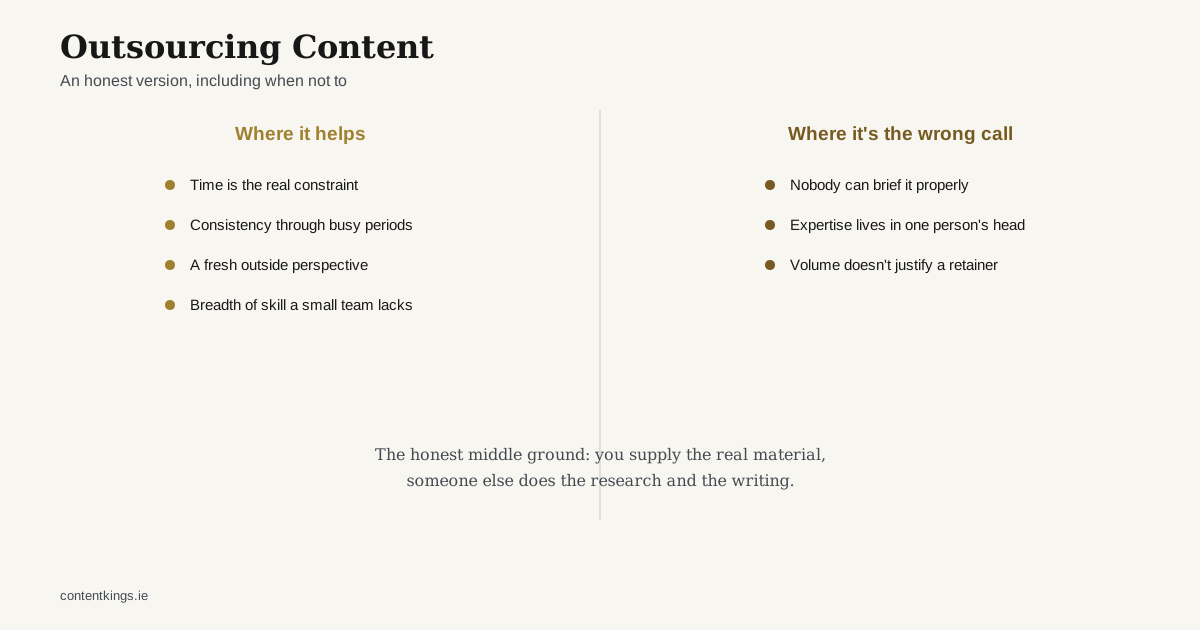
Most articles on this topic are written by agencies trying to sell outsourced content, which makes them a fairly unreliable source for the obvious reason. Here’s a version that includes the cases where outsourcing isn’t actually the right call.
Where outsourcing genuinely helps
Time is the most common real constraint. A business owner who’s also doing the actual work the business is built around (running a club, managing a site, delivering a service) rarely has a spare few hours a week to research, draft, and edit content to a professional standard. That’s not a failure of discipline - it’s a straightforward time allocation problem, and it’s the single most common reason outsourcing content makes sense in practice.
Consistency survives busy periods. In-house content production has an honest failure pattern: it happens reliably when things are calm and stops the moment things get busy, which is usually exactly when it would have mattered most. An external arrangement with its own schedule tends to hold up through the business’s own busy periods, because it isn’t competing for the same hours.
A fresh perspective on what’s actually interesting. People close to a business often can’t tell what’s genuinely distinctive about it anymore, because it’s just normal to them. An outside writer who asks “why would someone care about this” tends to surface the actual differentiator faster than someone who’s been inside the business for years.
Breadth of what’s needed. A content programme touching SEO structure, on-page writing, and genuine topic research draws on a few different skills that don’t always live in one person, especially at a small business.
Where it’s genuinely the wrong call
If nobody internal can brief it properly, outsourcing won’t fix that. An external writer, however good, can’t invent first-hand detail about your business, your clients, or your specific expertise. If there’s no one available to provide that raw material (real examples, real numbers, real opinions), outsourced content tends to default to generic, which is the exact failure mode this website’s own brief explicitly warns against.
If the content needs to be deeply technical and highly specific, and that expertise genuinely only exists in one person’s head, the honest answer might be that person needs to write it themselves (or be interviewed thoroughly and closely edited), rather than having someone paraphrase a brief they received second-hand.
If the volume genuinely doesn’t justify it. A business that needs four considered articles a year doesn’t need a retainer sized for weekly output. Outsourcing should match actual need, not a vendor’s preferred package size.
The honest middle ground
The arrangement that tends to work best in our own experience isn’t “hand it over entirely” or “do it all yourself” - it’s the business supplying the real, first-hand material (what actually happened, what you actually believe, what real clients actually asked) and an outside writer doing the research, structuring, and polished writing around that material. That split keeps the content genuinely grounded in the business while actually solving the time and consistency problem outsourcing is meant to solve in the first place.
If that’s the kind of arrangement you’re weighing up, we’re happy to talk through what it would actually look like for your specific content, not a generic package, via our content and strategy services.